
If you know me well, then you know getting me to party inside is a hard job. I thrive in open fields, under the sky, surrounded by nature. Walls and ceilings aren’t ideal—just give me a field, no buildings, thank you.
Nonetheless, when Dan from the Bristol-based folk punk collective Nasty Fishmonger invited me to their indoor all-dayer, the Commoners Fair, I knew I had to make an exception. This promised to be more than just any indoor gig—it was a gathering of like-minded people, a community event in a unique space.
A relatively new group, Nasty Fishmonger burst out from the background onto the harbourfront of Festivalland with their album Band of Common Folk last year. Originally just a scheme to get into events for free, the band’s initial few gigs were enormously successful, and their fanbase snowballed. Now, Nasty Fishmonger has reached the point where they are running their own micro-festival.

Held at Moor Beer Co. in Bristol, the Commoners Fair is, first and foremost, a Folk Punk festival—but don’t let that convince you it was a one-note event! Despite being focused entirely on a single genre, the variety within the Folk Punk portmanteau was impressive, with a mix of bluegrass, protest folk, sea shanties, and raw punk rock energy. Each act brought its own twist, adding depth to the overall experience and keeping things fresh.

The first musician I saw was Kale A Deane, a folksinger I first encountered with his band Admiral Backbar at Outcider, on the secondary acoustic stage. Mixing protest folk, sea shanties, and traditional Celtic music, Kale had a commanding stage presence and a voice that perfectly suited the genre. His energy was infectious, setting the tone for the rest of the day. He even threw in the Surfing Turnips’ classic ‘Turbo Island’—a nod to Kale’s love for The Dreadnoughts, who recorded the definitive version.

After Kale’s energetic set, it was time for the Stomp Swamp String Band. New to me, these guys delivered a waterspout of bluegrass dance energy. Unfortunately, I think they might have been on a bit early for the crowd to fully embrace their hardcore drinking songs, but they were undeniably brilliant. Their charisma was electric, and I found myself tapping along, even if others weren’t quite ready for it.

After that, we went back to the acoustic stage to catch A Day Without Love—surprisingly a singer-songwriter, on his own, not a full band. From Philidelphia in the US, while a bit on the soppy side, A Day Without Love’s set was meaningful and heartfelt, resonating with those in the audience looking for something more introspective.
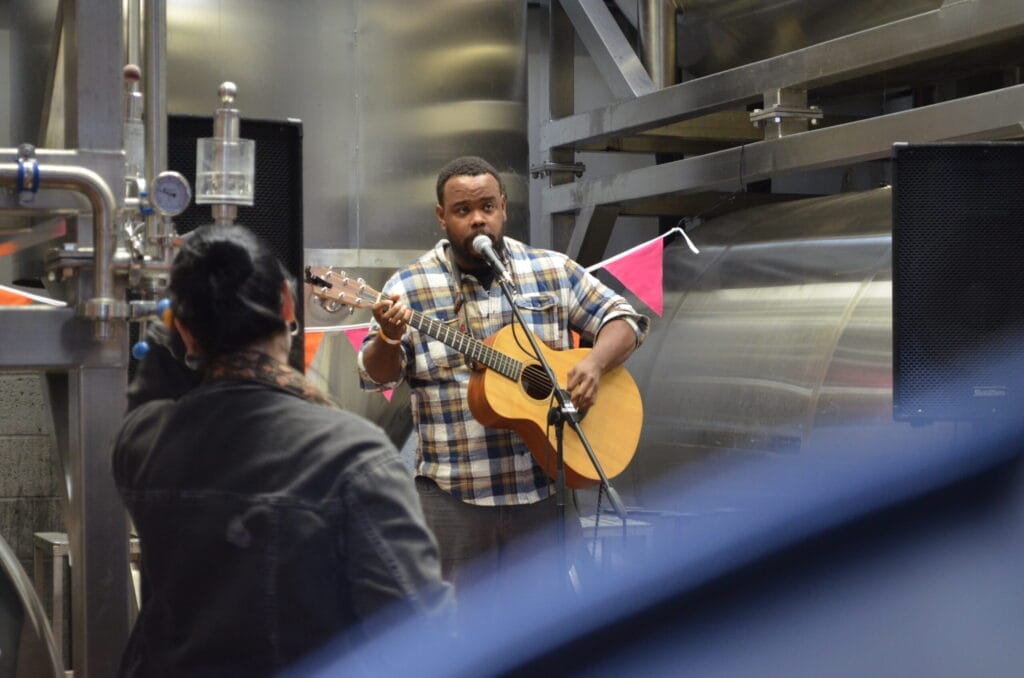
At this point, I decided to take advantage of the fact we were in a working brewery and get a beer. So’hop, one of the Moor Beer Company roster, was a tasty golden ale with strong, fresh flavours. As I sipped my beer, I began to appreciate Moor Beer Co’s industrial charm: a far more visually interesting setting than most music venues.

Its vats and pipes provided a unique backdrop, putting to shame the more common, sterile black-walled boxes. While yeah, viewing angles were a pain compared to these boring box venues, with said brewing vats and pipes in the way, that doesn’t matter in a mosh pit, and the brewery was never so crowded that people couldn’t move around a bit if they wanted a better view.

The next band filling the brewery with noise was Cheap Dirty Horse—epitomising the new wave of 2020s UK folk punk, they were hella queer and toted an accordion, which they were unafraid to put to solid use. With strong vocals and a sense of fun, they did not let their amazing band name down—an impressive feat, given how bold a name like Cheap Dirty Horse is.

After seeing CDH, I felt like a breather was needed. I headed outside, and that’s when I stumbled upon a hook-a-duck stand—where people had to volunteer to be the duck. Innovative and silly, the game was unique and fun, especially when two friends played rather than strangers, with ‘the duck’ waddling and weaving hard to avoid the ‘hooker’.
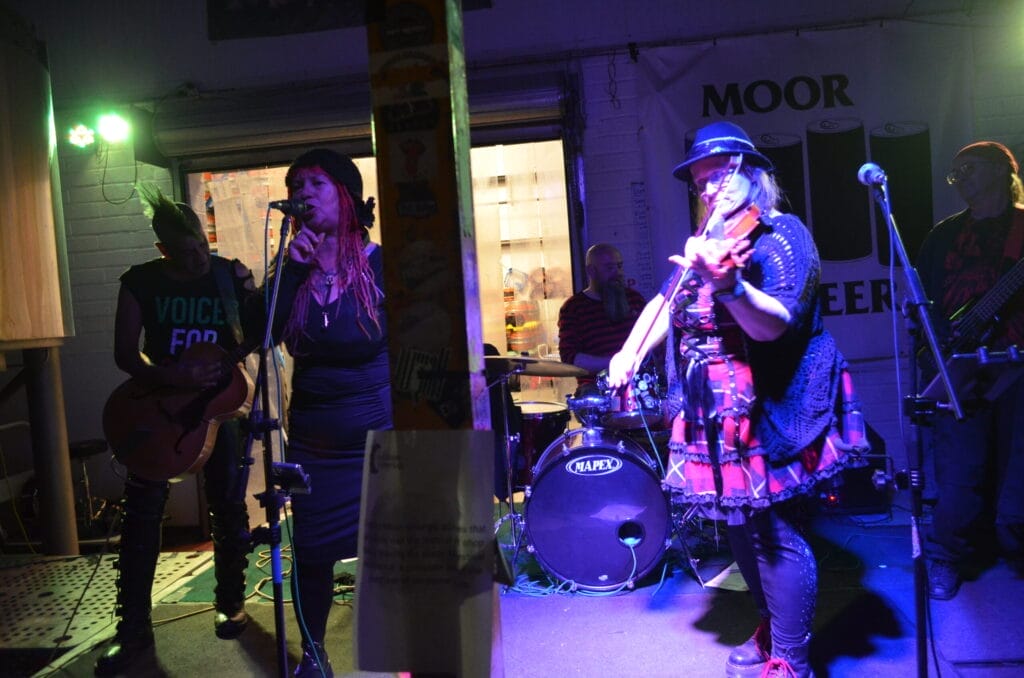
Once the laughter at the hook-a-duck died down, it was time to head back to the music, where Muddy Summers and the DFW were next—now, I’ve listened to enough festival bands to know that if there’s an acronym in their name, it’s probably rude, and DFW doesn’t let down, standing for Dirty Field Whores.

Deeply antifascist, with an old hippy, CND vibe, the highlight of Muddy Summers’ (a fictional character- the band are all DFW’s) set was a raucous version of “Bella Ciao,” the anthem of Italian partisans resisting fascism. It was a powerful reminder of the ongoing fight against oppression, delivered with all the raw energy it deserved. Its raw energy and passion captured the spirit of defiance perfectly.

The lefty political vibe continued with Efa Supertramp—comparatively quiet and calm, yet with an undercurrent of anger, the North Wales songstress closed the acoustic stage with her honest, personal music speaking of the potential for a better world.

At this point, I decided it was time to try another beer—this time a smoked lager, the so-called Golden Rauchbier. With a smokey nature, weirdly reminiscent of smoked cheese, the flavours were dramatic and substantial, unlike any beer I’ve ever had. While I greatly enjoyed drinking it, its intense flavour might be more of an acquired taste for some, making it one to nurse.

Performing second to last, and definitely the biggest band at the Commoners Fair, The Lagan were something rather special. Delivering their trademark Celtic Punk, the band offered far more than most of their contemporaries in the genre. Celtic Punk is often overdone to the point of parody—frequently played by ‘plastic paddies’ and full of exaggerated clichés—but The Lagan brought a sincerity to their performance that elevated it. They take their roots seriously while ensuring everyone is having fun. I particularly liked the slight ska influence they added to some of their songs, which helped to elevate them from just being another Celtic band.

Beyond its banging music lineup, the Commoners Fair also added something I want in every festival: a Boomtown-like narrative. It might have been small and low-key, but it was still immersive and engaging. In the story, the brewery was reimagined as a semi-legal fracking operation, overseen by Carmen R. Faire, CEO of Crooked Moon Enterprises. The industrial look of the brewery seamlessly supported the story, making the fracking operation all the more believable. It was an imaginative use of the space, seamlessly blending with the narrative and enhancing the immersive experience. However, Carmen’s environmental exploitation was only part of the story; she also used dark magic to bewitch her employees, including the mysterious Green Jack.
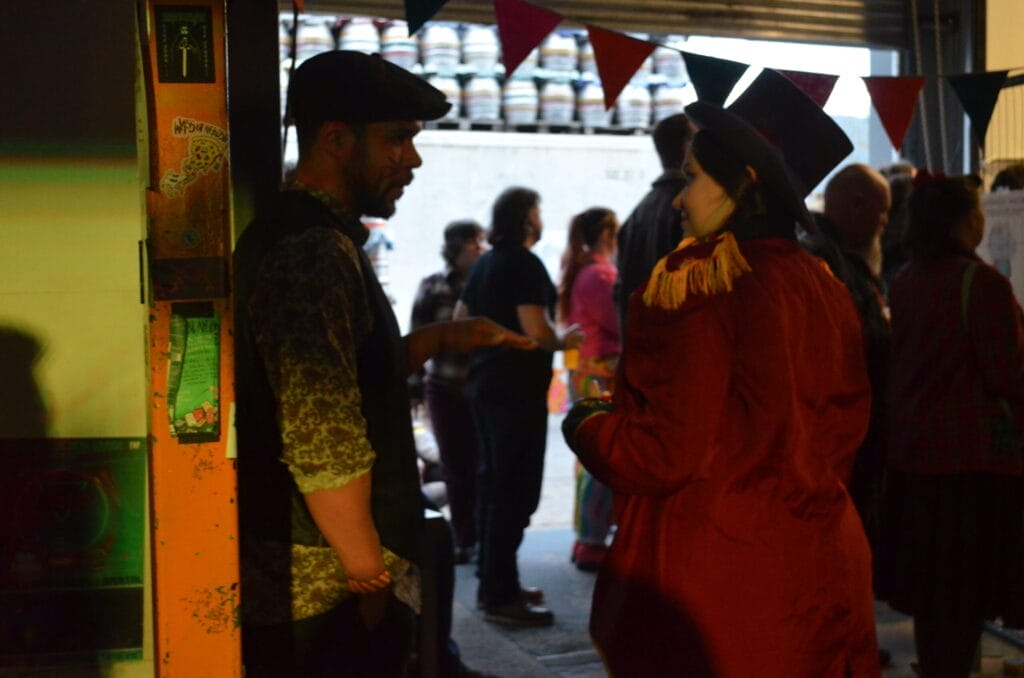
We learned this from a pair of animal-faced infiltrators, who sent us on a variety of quests, involving defacing Carmen’s posters, attaching pegs to our fellow festival-goers, and speaking to the “staff” at the entrance. The dedication of the cast was impressive—they stayed in character all day, making the experience feel authentic and drawing everyone into the storyline. Completing the quests, we acquired three words of power, named after the rivers running through the western country. We’d find out what these were useful for later, though interestingly when spoken to Carmen’s clearly bewitched staff, it caused them to freeze up in a pose.

When Carmen and Jack came on stage to introduce the final band, the narrative came to its climax, and before we all knew what we were doing, we were howling the words of power and doing the associated poses. Eventually, with the calling out of a final word of power, Turbo (probably referencing the infamous Bristol institution Turbo Island), Carmen shrank away, and Jack came back to his senses. Deploying his powers, a rumbling explosive sound took hold in the distance, and the festival seemed to shake for a moment as the sound effects signified he had “destroyed the fracking operation”. He then announced our headliners and hosts, Nasty Fishmonger.

I’ve grown to love Nasty Fishmonger over the last few months, and this has genuinely surprised me. By not caring about being ‘cool’ and fully embracing the cringe, they end up being much cooler and more genuinely punk than I could ever hope to be. Their songs are genuine and heartfelt, saying exactly what they believe, without the layer of cynicism I often associate with ‘serious’ music. While they have an oceanic gimmick, it’s never overbearing, and their vocals, songwriting, and musicianship are top-notch. Their sound blends fun, raw energy with genuine emotion, connecting with their audience in a deeply personal and powerful way.

Playing a long and varied set, the band roamed the musical seas, starting off with their heavy third-wave folk punk anthems, before shifting over to sea shanty corner, and then deploying their fantastic version of the common Welsh folk song “Dacw ‘Nghariad.” They finished their set with their anthem in honour of guitarist Dan’s sister’s mobility aid, a purple tricycle named Tallulah. Adding various interludes, the crowd went mental when the almost forgotten original song’s chorus returned.

The Commoners Fair was the quintessential ‘piss up in a brewery’—something uniquely special. Musically cohesive without being repetitive, and genuinely friendly without the typical cliquey vibe, it was the kind of event where strangers became friends. It was the kind of place where strangers quickly became friends, and the entertainment and atmosphere worked seamlessly together to create a natural sense of belonging. I arrived not really knowing anyone and left with dozens of new and solidified friendships.
The Commoners Fair filled Moor Beer co with smiling faces, and while it might be too niche and earnest to be traditionally ‘cool’, in the 2020s, authenticity is what truly resonates. By wearing its heart on its sleeve, the Commoners Fair easily stands among the best independent festivals in the West. I am glad it was such a success and am very excited to see what Nasty Fishmonger and friends have lined up for next year.
 Add as a preferred source